


الشركة
معلومات عنا
December 22, 2025
A lot of people read MIT’s State of AI in Business 2025(1) and came away with one headline:
“95% of AI projects fail, despite $30–40 billion in GenAI investment.”
It’s a striking figure. The report coins this the GenAI Divide — the widening gap between organisations that are experimenting with AI and those actually transforming with it. Across industries, enterprises have poured money into developing in-house generative AI solutions that ultimately fail to deliver measurable ROI — and, in many cases, fail to deliver a working solution at all.
But what caught my eye was something else:
“AI initiatives developed with external partners were about twice as likely to reach successful deployment as those built entirely in-house.”
That clarification matters.
As a clinician working at Tandem Health, I spend my time building AI that supports real everyday clinical workflows. That perspective makes the MIT finding feel less like a statistic and more like something I’ve watched unfold in real time. Across the health system, the same patterns repeat themselves:
Meanwhile, Tandem has gone from early-stage start-up to deployments across thousands of clinics, generating millions of hands-free clinical notes. Not because our models are magically different — but because we chose a different path: To be absolute specialists in our space, to deeply understand the pain points, and to continuously integrate those learnings into our partnerships.
The GenAI Divide report looked across industries and uncovered a trio of challenges that consistently undermine internal builds. The authors are explicit: The main barrier isn’t technical — it’s operational.
Most internal efforts fail because of:
It’s not that internal teams lack capability. It’s that it’s easy to underestimate the complexity of embedding AI into messy, fast-moving, unpredictable human workflows.
To build something genuinely impactful, you have to solve a very specific problem incredibly well — and dedicate serious capacity to improving that solution continuously. That’s a lot of headspace for a large enterprise to maintain as priorities and focuses shift.
There’s a helpful example from outside healthcare that illustrates this dynamic clearly.
Reducto — a YC company building document-ingestion infrastructure for AI systems — published a very interesting post on their experience in selling into a Fortune 10 organisation (2). What makes their story compelling isn’t just the scale of the buyer, but what happened during their evaluation process.
Midway through the process, Reducto realised that:
Despite this, Reducto won the deal.
Why? Because when the buyer compared the products side-by-side — accuracy, robustness, and performance under the messiness of real-world documents — the specialist team who had spent years solving that exact problem outperformed the internal build.
Reducto’s reflection on this is simple: internal teams possess organisational context, but specialist partners possess deep focus — and that dedication unlocks results.
It’s a concrete example of MIT’s “implementation advantage”: where the external partner succeeds not by being louder, but by being structurally set up to learn faster.
The report’s highest-performing organisations treat AI less as a piece of software and more as a service shaped directly around a workflow. That’s the lens we’ve built Tandem around.
Here’s what that means in practice.
1. Understand the Workflow Locally
At Tandem, more than 80% of our go-to-market and customer success team comes directly from clinical backgrounds. We’ve worked across international markets, and across the full spectrum of care settings — from GP practices to acute medical units.
So when we walk into any service, we’re not talking abstractly about architecture. We’re talking about:
The product reflects those lived realities because the people shaping it have lived them.
2. Build an Expert Implementation Team
MIT emphasises that organisations seeing real AI value treat it as a configured service, not a plug-and-play feature.
At Tandem, we:
And we don’t treat integration as an afterthought. Between our team and our collaborators, we’ve delivered 60+ EHR integrations across Europe, from lightweight connections to deep, bidirectional API partnerships — like with one of our key UK partners: Accurx. This gives us the ability to fit cleanly into existing infrastructures rather than forcing change around us.
3. Design for Continuous Learning
The line from MIT that stayed with me was:
“The core barrier to scaling is not infrastructure, regulation, or talent. It is learning.”
For us, that translates into:
And crucially: because we’re not burdened by 20 years of legacy architecture, we can ship improvements multiple times a week — and, when needed, multiple times a day. That cadence is profoundly difficult for internal teams or legacy vendors to match.
For us, continuous improvement isn’t a phase. It’s the operating model.
When I think about the two paths to take as an existing large player in this space: Internal builds on one side, strategic partnerships on the other, I see two possibilities.
In healthcare, the big EHR players, private providers, and internal scribe projects are, in many ways, reliving the same story already seen in finance and other sectors. Some may succeed. Many will quietly stall.
From where I sit — a front-line clinician now working inside an AI company — the lesson I take from the GenAI Divide is simple:
If you want AI that truly changes how care is delivered, don’t try to build it all yourself.
Partner with people whose entire job is to live in the workflow with you.
That’s the bet we’ve made at Tandem.
And it’s why, when I saw that “95% of projects fail” headline, what I really noticed was the opportunity underneath it:
Twice the likelihood of success when you choose your partners well.
References:
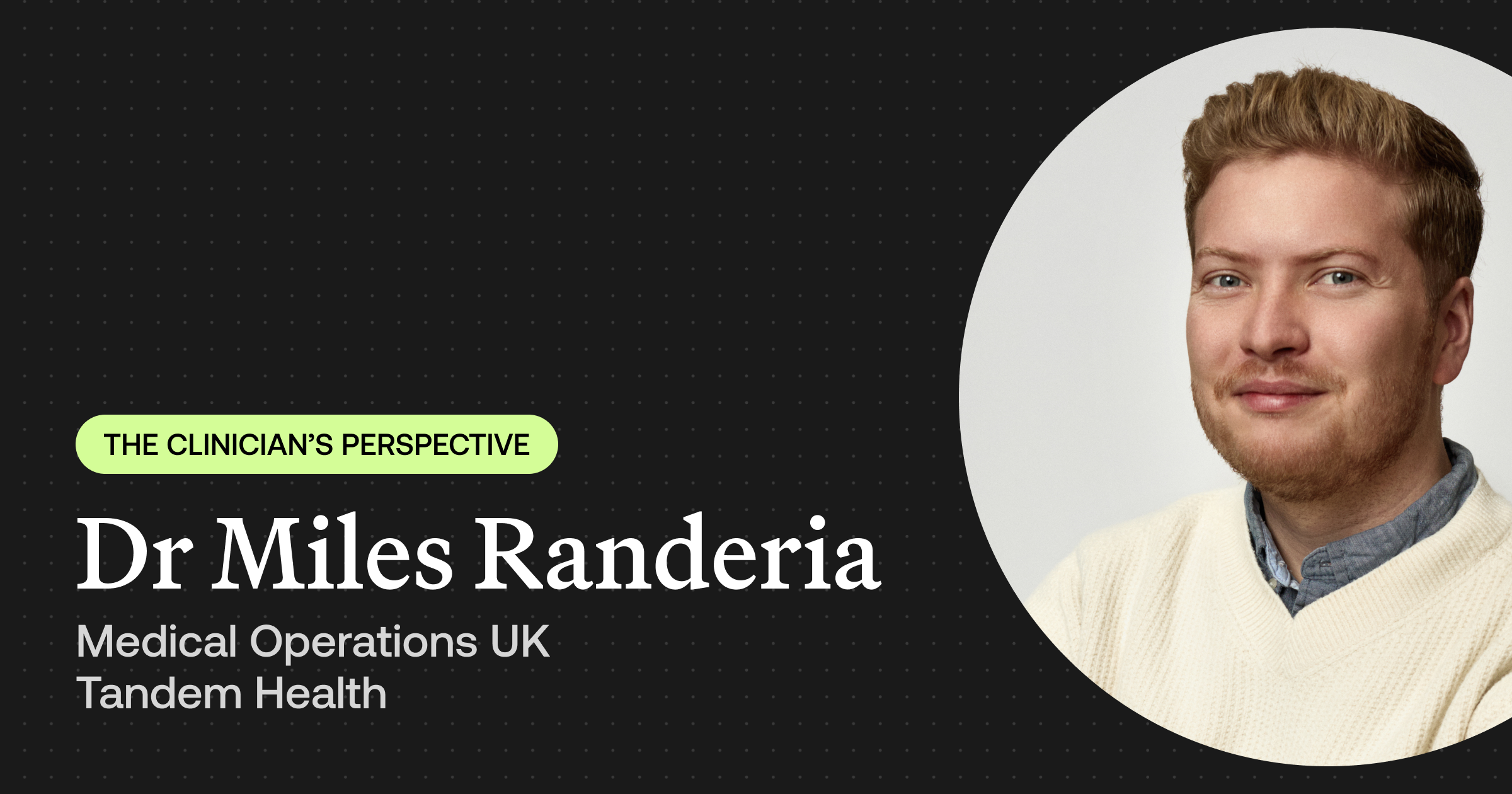
Miles is an NHS doctor with extensive experience in secondary care and emergency medicine. Now working in Medical Operations at Tandem Health, he leads the company’s expansion into acute hospital settings, combining deep clinical insight with a strong interest in AI and product to build solutions that improve patient care and clinician workflows.
Read more


