Tandems Coding Assistant is now MDR Class IIa certified, elevating the baseline for AI in clinical documentation
By
Tandem Health
·
·
Compliance
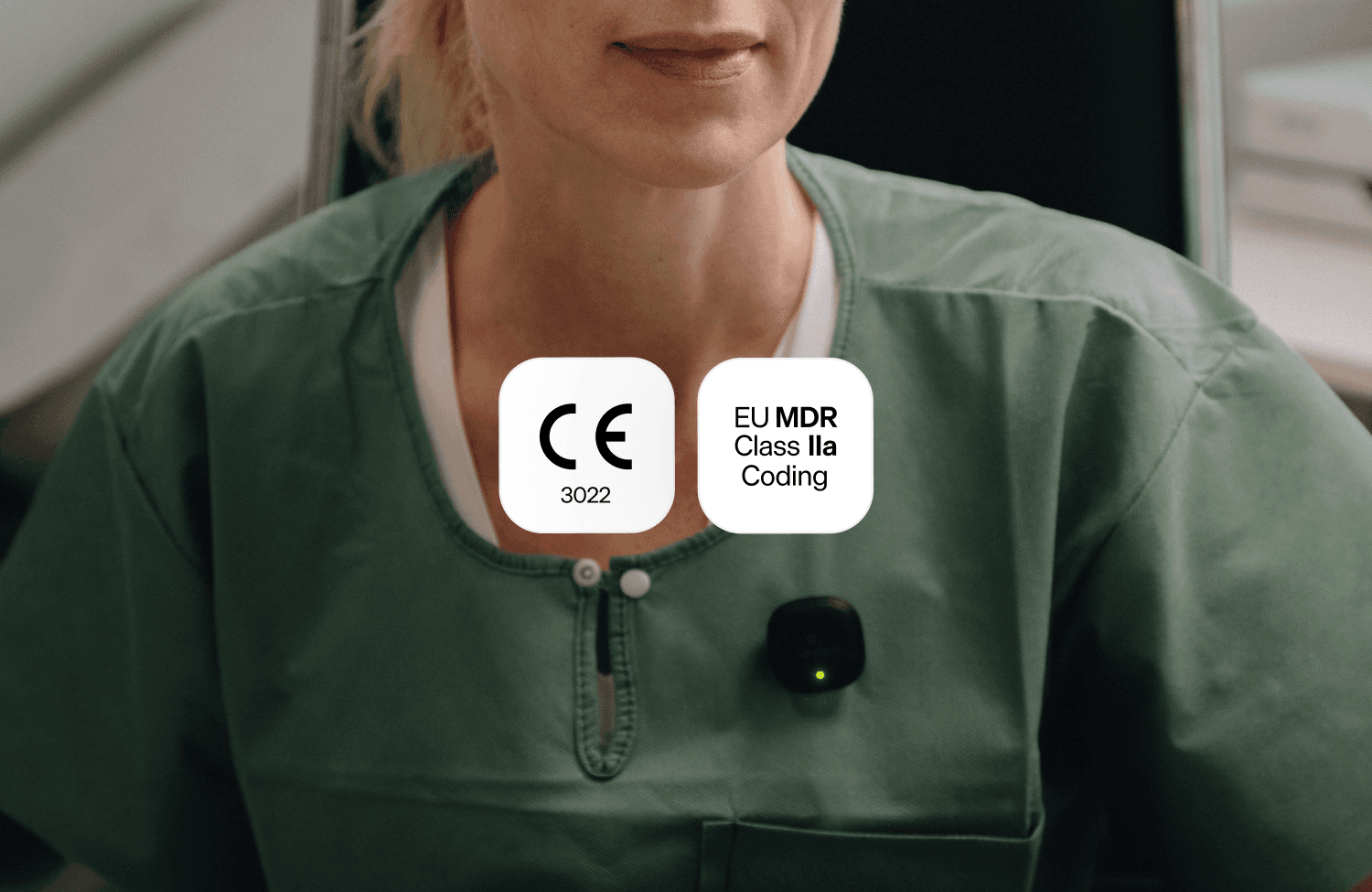
Tandem’s Coding Assistant is now certified under the EU Medical Device Regulation as a Class IIa medical device, following independent notified body review and formal conformity assessment.
Tandem is the first AI medical assistant in Europe with a certified product at this classification, building on our previously achieved ISO 13485 certification, ISO 27001 certification, and CE marking. We are also the second LLM-based product to ever achieve a Class II certification.
This isn’t merely a badge.
It’s a critical step in building regulated AI infrastructure for clinical workflows.
Tandem Health's vision is to build Europe's leading AI-native operating system for clinics. That requires regulatory alignment at infrastructure level.
Class IIa certification for our Coding Assistant reflects that direction. AI that supports clinical workflows must operate within clearly defined risk management, safety controls, and quality systems. This is how experimental tools mature into institutional systems.
That changes the conversation for care providers and decision makers.
How the Coding Assistant works in practice
Clinical coding translates a patient visit into structured diagnosis and procedure codes used for documentation, reporting, and reimbursement.
During the consultation, Tandem’s AI Medical Scribe listens, transcribes, and generates a structured clinical note.
Our Coding Assistant then also display relevant diagnosis and procedure codes as suggestions alongside the note.
We have built this to be scalable across Europe and support all national coding frameworks.
At the end of the visit, the clinician can thus easily select the relevant codes - which are transferred automatically to the medical record system together with the medical note.
How Class IIa lowers risk and removes friction
Class IIa reduces existing uncertainty for healthcare organisations looking to deploy AI safely in regulated, patient-facing environments.
For healthcare organisations, this matters in three practical ways.
Regulatory uncertainty is reduced
Procurement teams don't need to interpret classification questions internally. The regulatory position is clear and independently assessed.
Patient safety risk is formally controlled
The system operates within a structured, externally assessed risk management framework, with defined intended use and mandatory human oversight.
Deployment risk drops significantly
Legal, compliance, and information governance reviews become more straightforward when the product already meets MDR Class IIa requirements. In practice, AI adoption often slows due to governance complexity rather than technical performance. Class IIa removes a significant portion of that friction.
This is what allows clinical AI support to move from pilot to operational deployment.
Why does Coding Assistant fall under Class IIa
Under EU MDR 2017/745 Rule 11, solutions that can potentially inform diagnoses and treatment are classified as Class IIa.
The Coding Assistant falls under this as it suggests both diagnoses and treatment codes, which are selected and documented together with the visit. These will also be used as a basis for future patient visits and treatment provided, when the next clinician reviews the patient’s medical history.
In the UK, the NHS has also published clear guidelines stating that clinical coding falls under Class IIa.
MDR certified AI product development as a core capability
As we venture from developing an AI Medical Scribe to an AI-native clinic operating system, a majority of the components will impact the care provided and thus require MDR certifications of higher risk classes.
We recognize this and are setting ourselves up as a company to quickly be able to develop and release MDR certified AI products. To ensure we can continue releasing improvements and new features on a daily basis. Rather than shifting to quarterly release cycles, as companies typically do once reaching higher risk classifications.
At the core of this is our deep medical expertise. Almost half of all Tandem colleagues, including our regulatory and compliance team, has a clinical background. Ensuring we understand the risks and requirements.
A unified regulatory position across Europe and the UK
The Coding Assistant holds MDR Class IIa certification for the EU.
Under current transitional arrangements, that certification is also recognised in the UK.
This creates a unified regulatory position across Europe.
For NHS organisations and UK public health bodies, this means:
No separate regulatory pathway
No classification ambiguity
No delay while frameworks evolve
Tandem’s product is positioned to scale within existing regulatory and procurement structures.
A new regulatory baseline for AI in clinical workflows
AI in healthcare is moving from experimentation to infrastructure.
Class IIa certification signals that clinical documentation support is not simply a standalone feature but part of a regulated, quality managed foundation for clinical workflows.
For providers, this lowers risk.
For procurement teams, this removes uncertainty and friction.
For healthcare systems, this creates a clearer path from pilot to wide adoption.
And for Tandem Health, it's another step toward building Europe's AI-native operating system for clinics, designed to serve as a long-term partner for healthcare providers.


